Dhafiq Sagara adalah orang bodoh yang tidak bisa apa-apa, tapi dia selalu berusaha untuk terus menjadi yang lebih baik. Rasa keingin-tahuannya sangat tinggi, selalu berusaha dan terus berusaha, trial dan error adalah prinsip belajarnya.

Tampilkan postingan dengan label E-Book. Tampilkan semua postingan

6 Okt 2011

Download E-book Design Patterns For Dummies

There are plenty of design patterns floating around the programming world, and in time, a particular set of 23 of them has become accepted as the standard set. These patterns were first corralled in a book named Design Patterns: Elements of Reusable Object-Oriented Software (1995, Pearson Education, Inc. Publishing as Pearson Addison Wesley) by Erich Gamma, Richard Helm, Ralph Johnson, and John Vlissides — who have since been called the Gang of Four, or GoF, for short. And those 23 design patterns became known as the GoF design patterns.
You see all 23 of those standard patterns in this book, and some additional ones as well. I explain what each pattern does and when you should use the pattern. You also see a programming problem that the design pattern solves, implemented in code. In other words, every design pattern is put to work in easily understandable, runable code in this book.

In fact, some of the design patterns have already been put to work by the people who wrote the Java programming language. In such cases, I also discuss the part of Java that implements the design pattern already — such as closing windows in Swing or registering listeners with event-causing objects. Doing so gives you an immediate leg up with the design patterns covered — hey, you might find yourself saying: That looks familiar.

Download Ebook Design Patterns For Dummies.
From Google Docs Design Patterns For Dummies.

5 Okt 2011

Download E-Book More Servlet And JavaServer Pages

Servlet adalah sebuah API dalam pemrograman java yang mempermudah para developer untuk menambahkan konten-konten dinamis dalam sebuah web server yang mengimplementasikan platform java. Konten yang dihasilkan dari Servlet API ini pada umumnya berupa HTML, tetapi tidak menutup kemungkinan untuk menghasilkan konten XML dan konten-konten yang lain. Servlet sendiri dibuat untuk menandingi teknologi-teknologi konten web yang dinamis lainnya seperti PHP, CGI, ASP.NET.

Sedangkan JSP (JavaServer Pages) merupakan teknologi yang didasarkan pada bahasa Java, yang dapat digunakan untuk membentuk halaman-halaman Web yang bersifat dinamis. Teknologi ini dikembangkan oleh Sun Microsystems.


Silahkan Download E-Book More Servlet and JavaServer Pages.

Ebook More Servlet and JavaServer Pages ini terdapat 11 Chapter, antara lain:
  1. CHAPTER 1: SERVER SETUP AND CONFIGURATION
  2. CHAPTER 2: A FAST INTRODUCTION TO BASIC SERVLET PROGRAMMING
  3. CHAPTER 3: A FAST INTRODUCTION TO BASIC JSP PROGRAMMING
  4. CHAPTER 4: USING AND DEPLOYING WEB APPLICATIONS
  5. CHAPTER 5: CONTROLLING WEB APPLICATION BEHAVIOR WITH WEB.XML
  6. CHAPTER 6: A SAMPLE WEB APPLICATION: AN ONLINE BOAT SHOP
  7. CHAPTER 7: DECLARATIVE SECURITY
  8. CHAPTER 8: PROGRAMMATIC SECURITY
  9. CHAPTER 9: SERVLET AND JSP FILTERS
  10. CHAPTER 10: THE APPLICATION EVENTS FRAMEWORK
  11. CHAPTER 11: NEW TAG LIBRARY FEATURES IN JSP 1.2

23 Mei 2011

E-Book CakePHP - Beginning CakePHP From Novice to Professional

This guide is for beginners to CakePHP. Whether or not you have much experience with the PHP scripting language, working in Cake will require some new methods you may or may not have tried before. If you don’t know what a "has-and-belongs-to-many" relationship is, don’t know how to build your own class object, or don’t know how to parse an array, then this book is a perfect place to start when getting into Cake.

Most of the available online resources require some sort of prior knowledge of web development to get a grasp on how to install and work in Cake. If you’re like me when I started using Cake, you probably just want a handful of tutorials with code samples from square one that can get you up and running quickly and lead you in the right direction for more advanced techniques. In fact, when asking a question on forums or chat rooms, many beginners get little help or confusing leads from the experts. Simple questions can get a response like "Well, just read the online manual and API." Sometimes novices need a very simple approach to the software, and this guide is just that. As you begin to master Cake, this guide will also provide tips and a reference for helping you quickly add more features to your projects and catch errors.

This book will start by showing how to install Cake on a server and your own computer and will provide some detailed code samples and visual snapshots to walk you through the process. In Chapter 2, I’ll show how to build a simple Cake application. You’ll get used to the Model-View-Controller (MVC) structure and how to organize your Cake applications effec-tively. In Part 2, you’ll build more extensive web applications in Cake, and you’ll explore Cake’s built-in helpers, including the Ajax helper, and work with more advanced features. By the end of the book, you will be able to create your own helpers, plugins, and other useful features that will reduce the overall amount of code to run your applications, and you’ll also have a solid enough foundation to try other advanced features on your own.

Panduan ini diperuntukkan bagi pemula untuk CakePHP. Apakah Anda punya banyak pengalaman dengan bahasa PHP scripting, yang bekerja di Cake akan memerlukan beberapa metode baru Anda mungkin atau tidak mungkin telah mencoba sebelumnya. Jika Anda tidak tahu apa yang "memiliki-dan-milik-ke-banyak" hubungan ini, tidak tahu bagaimana membangun objek kelas Anda sendiri, atau tidak tahu bagaimana mengurai sebuah array, maka buku ini adalah tempat yang sempurna untuk memulai ketika masuk ke Cake.

Sebagian besar sumber daya online yang tersedia memerlukan beberapa jenis pengetahuan sebelumnya pengembangan web untuk mendapatkan pemahaman tentang cara menginstal dan bekerja di Cake. Jika Anda seperti saya ketika saya mulai menggunakan Cake, Anda mungkin hanya ingin sedikit tutorial dengan contoh kode dari satu persegi yang dapat membuat Anda bangun dan berjalan cepat dan membawa Anda ke arah yang benar untuk teknik yang lebih maju. Bahkan, ketika mengajukan pertanyaan di forum atau chat room, banyak pemula mendapatkan sedikit bantuan atau arahan membingungkan dari para pakar. pertanyaan sederhana bisa mendapatkan respon seperti "Yah, hanya membaca panduan online dan API." Kadang-kadang siswa membutuhkan pendekatan yang sangat sederhana untuk perangkat lunak, dan panduan ini hanya itu. Ketika Anda mulai menguasai Cake, panduan ini juga akan memberikan tips dan referensi untuk membantu Anda dengan cepat menambahkan lebih banyak fitur untuk proyek-proyek Anda dan menangkap kesalahan.

Buku ini akan memulai dengan menunjukkan cara menginstal Cake pada server dan komputer sendiri dan akan memberikan beberapa contoh kode rinci dan snapshot visual untuk memandu Anda melalui proses tersebut. Dalam Bab 2, saya akan menunjukkan bagaimana membangun sebuah aplikasi Cake sederhana. Anda akan mendapatkan digunakan untuk struktur (MVC) Model-View-Controller dan bagaimana Anda mengatur aplikasi Kue effec-tively. Dalam Bagian 2, Anda akan membangun aplikasi web yang lebih luas di Cake, dan Anda akan menjelajahi Cake built-in pembantu, termasuk penolong Ajax, dan bekerja dengan fitur yang lebih maju. Pada akhir buku ini, Anda akan mampu menciptakan helper sendiri, plugin, dan fitur berguna lainnya yang akan mengurangi jumlah keseluruhan kode untuk menjalankan aplikasi Anda, dan Anda juga akan memiliki dasar yang cukup kuat untuk mencoba lanjutan lainnya fitur sendiri.

Download E-Book CakePHP:
E-Book CakePHP - Beginning CakePHP From Novice to Professional (Google Docs)

16 Apr 2011

E-Book Android - Pro Android

This book is for software developers interested in writing mobile applications with the Android SDK. Because Android is a fairly new technology, anyone interested in building mobile applications using the Java™ platform will also benefit from this book. In addition, software architects and business-development professionals can use this book to get an understanding of the Android Platform’s capabilities.


This book covers the Android SDK. It’s broken up into 13 chapters, as follows:

  • Chapter 1, "Introducing the Android Computing Platform"
    This chapter introduces you to the Android Platform and its basic building blocks. It also gives you an overview of the Android subsystems by showing you the high-level packages within the Android SDK. Plus, we provide information on Android’s specialized virtual machine that addresses the limitations of handheld devices.
  • Chapter 2, "Getting Your Feet Wet"
    In this chapter, we show you how to set up a development environment for Android programming. We then walk you through a basic application and introduce you to some of the Android components. We also cover the application lifecycle and familiarize you with some debugging tools.
  • Chapter3, "Using Resources, Content Providers, and Intents"
    Here we cover several of the fundamental pillars of the Android Platform—resources, content providers, and intents. We explain what resources are and how they function in an Android application. We demonstrate how to use content providers as a mechanism for abstracting data into services. We define intents and show you how to use them as a generic way to request action.
  • Chapter 4, "Building User Interfaces and Using Controls"
    This chapter is all about building user interfaces with the Android widget toolkit. We first cover building UIs programmatically, then cover Android’s preferred way of defining UIs-in XML layout files. We also discuss Android’s layout managers and view adapters. Plus, this chapter provides an introduction to the Hierarchy Viewer tool, which you use to optimize UIs.
  • Chapter 5, "Working with Menus and Dialogs"
    Here we extend our discussion on UI programming in Android by talking about menus and dialogs. We show you Android’s philosophy on building menus, and then discuss the various types of menus available in the Android SDK. We also talk about dialog components.
  • Chapter 6, "Unveiling 2D Animation"
    In this chapter, we discuss Android’s 2D animation capabilities. We show you how to animate views to make your applications more appealing. Specifically, we cover three categories of animation: frame-by-frame animation, layout animation, and view animation.
  • Chapter 7, "Exploring Security and Location-Based Services"
    This chapter covers Android’s security model and location-based services. In the first part, we show you Android’s security requirements and then show you how to secure your applications. In the second part, we talk about location-based services, which is a fundamental aspect of a mobile device. We show you Android’s support for mapping and then show you how to customize a map with data specific to your application. We also cover geocoding in this chapter.
  • Chapter 8, "Building and Consuming Services"
    This chapter is about building background services in Android. Here, we talk about building services that are local to your application, as well as remote services, services that can be consumed by other applications running on the device. Remote services are based on Android Interface Definition Language (AIDL), so we show you how to define AIDL types and files. We also describe how to pass types across process boundaries.
  • Chapter 9, "Using the Media Framework and Telephony APIs"
    This chapter shows you how to build media-capable applications with the Android SDK. We talk about playing audio and video and then show you how to record audio. We cover text messaging in the telephony part of the chapter.
  • Chapter 10, "Programming 3D Graphics with OpenGL"
    Here, you learn how to implement 3D graphics using OpenGL. We show you how to set up OpenGL with your applications and then cover the basics of OpenGL and OpenGL ES. We cover some of the essential OpenGL ES APIs and build a test harness that you can use to exercise those APIs.
  • Chapter 11, "Managing and Organizing Preferences"
    In this chapter, we talk about Android’s preferences framework. We show you that Android has built-in support for displaying and persisting preferences. We discuss three types of UI elements: CheckBoxPreference, EditTextPreference, and Ringtone Preference. We also talk about organizing preferences within your applications.
  • Chapter 12, "Coming to Grips with 1.5"
    Chapter 12 discusses some of the changes in the Android 1.5 SDK. Specifically, we talk about some of the SDK’s new tools and a few of the most exciting APIs. For example, you’ll learn about the new UI wizard that creates Android resources, the new speech-recognition intent, intents to record audio and video, video capture using the MediaRecorder, and more. You’ll also get a short introduction to Android’s input-method framework (IMF) implementation.
  • Chapter 13, "Simplifying OpenGL and Exploring Live Folders"
    This chapter begins by covering the OpenGL-related changes in Android 1.5 and then discusses the new live-folder framework. As you’ll see, the Android 1.5 SDK offers some additional abstractions to the OpenGL APIs that make it easier for you to build applications that utilize 3D graphics. We also talk at length about a new concept called live folders, which allow you to expose content providers such as contacts, notes, and media on the device’s default opening screen.

Download E-Book:
  1. Pro Android (enterupload.com)
  2. Pro Android (4share.com)
  3. Pro Android (Google Docs)

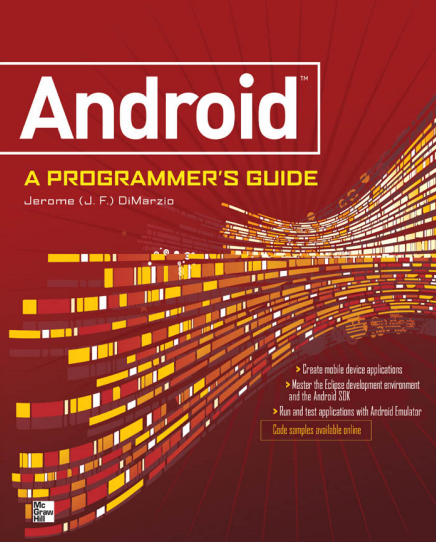
E-Book Android - Android A Programmer's Guide

Welcome to Android: A Programmer’s Guide. This book has been designed to give you the best first step toward the exciting new frontier of open source mobile development. Android is the newest mobile device operating system, and this is one of the first books to help the average programmer become a fearless Android developer. Through the course of this book, you will be introduced to the fundamentals of mobile device application development using the Open Handset Alliance’s Android platform. By the end of this book, you will be able to confidently create your own mobile device programs.

The format of this book is such that it will take you through Android application development in a logical manner. The book begins by examining the architecture of Android as a platform, looking at how it was developed, what it can run on, and what tools are required to develop programs for it. Afterdiscussing and installing the development tools, Android SDK, and the Eclipse development environment (Chapters 2, 3, and 4), the book dives directly into designing and creating Android applications (Chapter5). The book concludes with instructions on tying your applications to existing Google tools such as Google Maps (Chapters 9 and 11) and GTalk (Chapter 10). A quick reference guide is also included in Chapter 12.

This book is a programmer’s guide, not a beginner’s guide, meaning that you do need to possess some programming skills to get the most from it. Foremost among these skills is a working knowledge of Java programming fundamentals. Android applications are  developed in Java and run on the Linux 2.6 kernel. If you area quicklearner, you maybe able to understand what is going on with just some basic object-oriented programming (OOP) experience. Chapter 2 explains how to download and install the preferred integrated development environment, Eclipse. All the code samples and screenshots in this book are provided using Eclipse (Europa release) and the Android plugin for Eclipse.


Selamat Datang di Android: Panduan Programmer. Buku ini telah dirancang untuk memberikan langkah terbaik pertama menuju perbatasan baru yang menarik dari pengembangan open source mobile. Android adalah sistem operasi terbaru perangkat mobile, dan ini adalah salah satu buku pertama untuk membantu programmer rata-rata menjadi seorang pengembang Android tak kenal takut. Melalui program buku ini, Anda akan diperkenalkan ke dasar-dasar pengembangan aplikasi perangkat mobile menggunakan Open Handset Alliance platform Android. Pada akhir buku ini, Anda akan dapat percaya diri membuat program Anda sendiri perangkat mobile.

Format dari buku ini adalah sedemikian rupa sehingga akan membawa Anda melalui pengembangan aplikasi Android secara logis. Buku ini dimulai dengan memeriksa arsitektur Android sebagai platform, melihat bagaimana hal itu dikembangkan, apa yang bisa berjalan pada, dan apa alat yang diperlukan untuk mengembangkan program untuk itu. Afterdiscussing dan menginstal alat pengembangan, Android SDK, dan lingkungan pengembangan Eclipse (Bab 2, 3, dan 4), buku penyelaman langsung ke dalam merancang dan membuat aplikasi Android (Chapter5). Buku ini diakhiri dengan petunjuk pada mengikat aplikasi Anda ke alat Google yang ada seperti Google Maps (Bab 9 dan 11) dan GTalk (Bab 10). Sebuah panduan referensi cepat juga termasuk dalam Bab 12.

Buku ini adalah panduan programmer, bukan panduan pemula, yang berarti bahwa Anda perlu memiliki beberapa keterampilan pemrograman untuk mendapatkan hasil maksimal dari itu. Terutama di antara keterampilan-keterampilan ini adalah pengetahuan tentang dasar-dasar pemrograman Java. aplikasi Android dikembangkan di Jawa dan berjalan di kernel Linux 2.6. Jika Anda quicklearner area, Anda mungkin dapat mengerti apa yang terjadi hanya dengan beberapa pemrograman berorientasi objek dasar (OOP) pengalaman. Bab 2 menjelaskan cara men-download dan menginstal lingkungan pengembangan terintegrasi yang disukai, Eclipse. Semua sampel kode dan screenshot dalam buku ini diberikan menggunakan Eclipse (Europa rilis) dan Android plugin untuk Eclipse.


Download E-Book:
  1. E-Book Android A Programmer's Guide (Enterupload.com)
  2. E-Book Android A Programmer's Guide (4shared.com)
  3. E-Book Android A Programmer's Guide (Google Docs)

E-Book Android - Android Essentials

This book covers the essential information required to build an Android application. It will help any developer, amateur, professional, or dabbler who is interested in developing for Android. Over the course of the book, I cover the essentials you’ll need to get started with your own innovative application. I took on this project because, after five years of working in the mobile  software industry, it has become clear that we need help. With mobile devices becoming more ubiquitous, powerful, and, indeed, essential, fresh blood is necessary to overcome the stagnation that has plagued our business. As an industry, we need to graduate from making cookie-cutter ringtones, wallpaper, and e-mail applications. I hope, once you’ve finished this book, that you’ll be in a position to start that killer mobile product you’ve told all your friends you’re going to make.


In Android Essentials, I cover the details of installing and using the Android SDK, making and rendering user interface tools, harnessing location tracking and Google Maps, and putting everything together with a little glue from XML parsers and networking clients. These tools and tricks should be enough to get you past your empty editor, the daunting blank canvas of the developer world, and onto the path of your own innovative mobile app. Android potentially represents our best hope for a break from the constricted world of mobile development. Use it to make something amazing. I can’t wait to see what you create.


Buku ini mencakup informasi penting yang diperlukan untuk membangun aplikasi Android. Ini akan membantu pengembang apapun, amatir, profesional, atau amatir yang tertarik dalam pengembangan untuk Android. Selama buku ini, saya menutupi penting yang Anda perlukan untuk memulai dengan aplikasi inovatif Anda sendiri. Aku mengambil proyek ini karena, setelah lima tahun bekerja di industri perangkat lunak ponsel, hal itu telah menjadi jelas bahwa kita membutuhkan bantuan. Dengan perangkat mobile menjadi lebih di mana-mana, kuat, dan, memang, penting, darah segar diperlukan untuk mengatasi stagnasi yang telah menjangkiti bisnis kami. Sebagai sebuah industri, kita harus lulus dari membuat kue-cutter nada dering, wallpaper, dan aplikasi e-mail. Saya harap, setelah Anda selesai buku ini, bahwa Anda akan berada dalam posisi untuk memulai bahwa produk pembunuh selular Anda telah memberitahu semua teman anda Anda akan buat.

Dalam Android Essentials, saya menutupi rincian menginstal dan menggunakan SDK Android, membuat dan rendering antarmuka pengguna alat, memanfaatkan pelacakan lokasi dan Google Maps, dan meletakkan segala sesuatu bersama-sama dengan sedikit lem dari parsing XML dan klien jaringan. Alat-alat dan trik harus cukup untuk Anda melewati editor kosong, kanvas kosong menakutkan dari dunia pengembang, dan ke jalan aplikasi mobile Anda sendiri yang inovatif. Android berpotensi mewakili harapan terbaik kita untuk istirahat dari dunia terbatas pembangunan mobile. Gunakan untuk membuat sesuatu yang menakjubkan. Saya tidak bisa menunggu untuk melihat apa yang Anda buat.


Download E-Book:
  1. E-Book Android Essentials (4shared.com)
  2. E-Book Android Essentials (google docs)